
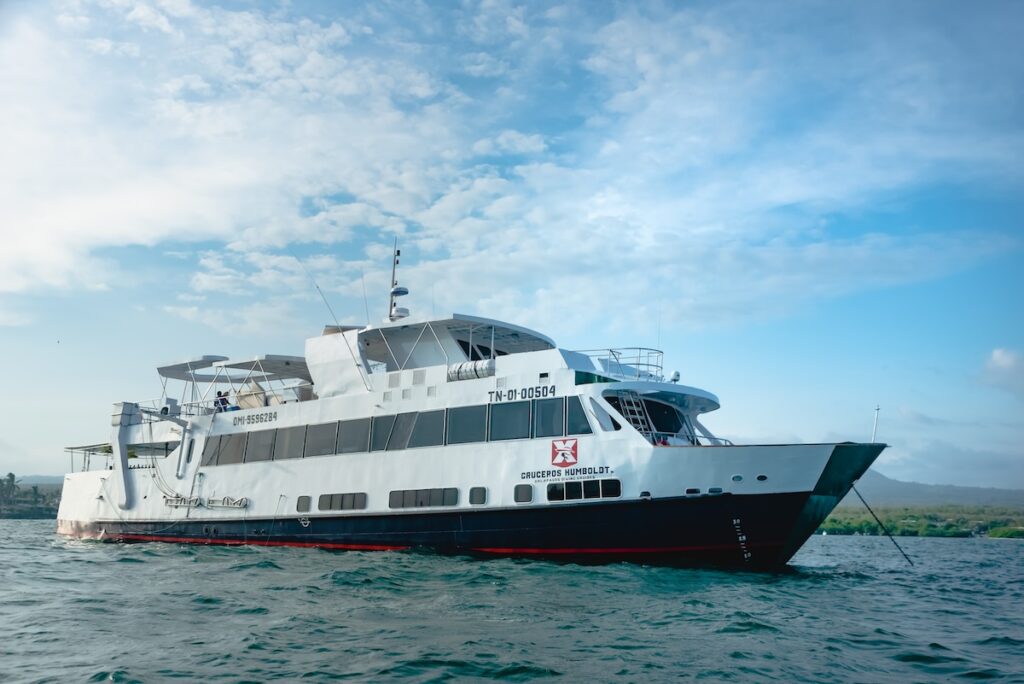
How Explorer Ventures’ liveaboards Humboldt Explorer® and Tiburon Explorer® became the Galapagos’ only PADI Eco-Centers and what the process revealed about sustainability in remote marine environments
Becoming a PADI Eco-center is a significant achievement for any dive operation. Doing so aboard a liveaboard introduces another layer of complexity. Operating in the Galapagos adds another still.
Unlike land-based businesses, liveaboards function as floating hotels, restaurants, dive operations, and workplaces for days at a time. Water is produced onboard. Waste must be stored until it can be properly handled ashore. Guests live, dive, eat, and learn together in a shared environment. Every operational decision happens far from the infrastructure many businesses rely on.
In the Galapagos Islands, those realities are layered on top of some of the world’s strictest marine conservation regulations and that combination makes Humboldt Explorer and Tiburon Explorer unique.
Today, they are the only PADI Eco-centers operating in the Galapagos. The designation recognizes operators that combine participation in PADI AWARE’s Adopt the Blue program with demonstrated environmental performance through Green Fins.
For Explorer Ventures Fleet®, the designation was years in the making. Much of the work had already been underway long before the Eco-center program existed.
Building on an Existing Foundation
Explorer Ventures introduced its Dive Green® environmental program for the company in 2008 to reduce the fleet’s environmental footprint and build sustainability into daily operations.
Over time, the program evolved through experience, environmental partnerships, and lessons learned from liveaboards running in some of the world’s most remote and ecologically important dive destinations.
In 2018, Explorer Ventures became the first liveaboard company to establish a symbiotic partnership with The Reef-World Foundation. The relationship helped strengthen their existing Dive Green program while providing access to the Green Fins framework and global best practices.
Years later, when PADI introduced the Eco-Center designation, Humboldt Explorer and Tiburon Explorer were well positioned to earn the recognition, already being active Green Fins members.
“We’ve always approached our operations with sustainability in mind,” says Clay McCardell, Owner of Explorer Ventures Fleet. “What Green Fins brought was structure, documentation, and a transferable framework that helped us strengthen those efforts and apply them more consistently across the fleets.”
For the fleet, the designation was a natural extension of work that was already happening across the globe. It was building on years of work and demonstrating what is possible within the liveaboard sector.
“The dive industry has made tremendous progress around sustainability since we launched our Dive Green Program in 2008” says McCardell. “Liveaboards operate differently from many other businesses. If our experience can help move standards forward, encourage adoption, or show other operators what’s achievable, that’s a meaningful outcome.”
From Green Fins Member to PADI Eco-center
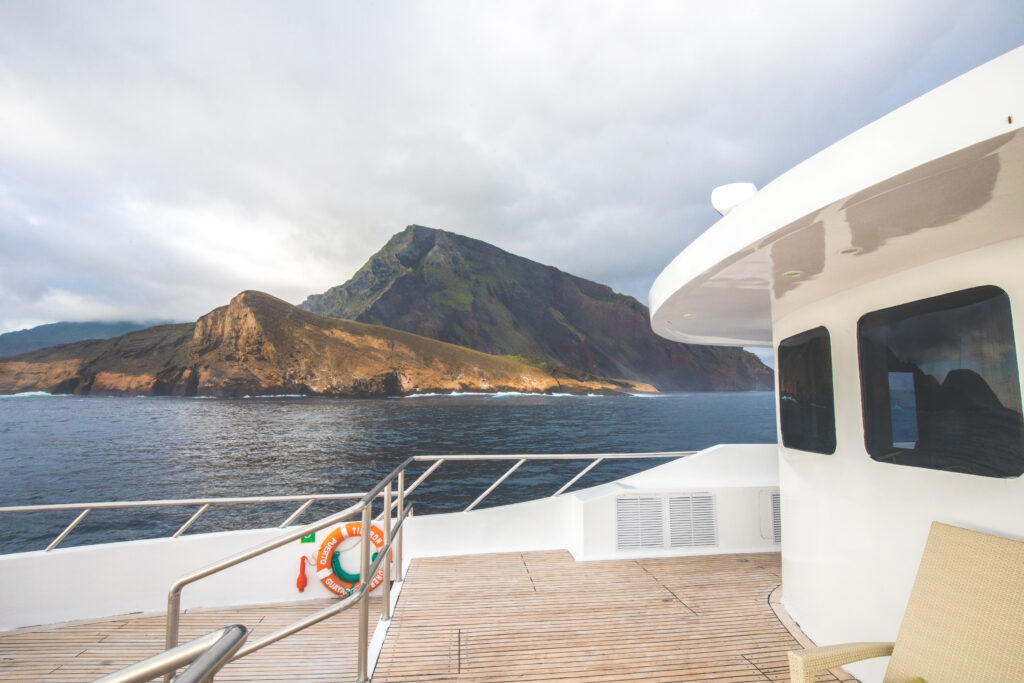
Galapagos landscape from the Tiburon Explorer | © Explorer Ventures Fleet®
The path to becoming a PADI-Eco Center involves much more than meeting a checklist. Operators must participate in PADI AWARE’s Adopt the Blue program, maintain a Green Fins membership with strong environmental performance, commit to ongoing action plans, and engage with the wider Green Fins community.
For Humboldt Explorer and Tiburon Explorer, the process was less about overhauling operations and more about formalizing and documenting practices that were already part of the way the vessels operated.
Many of the environmental measures, crew practices, and guest education efforts were already in place. The work focused on aligning those existing efforts with Green Fins standards, strengthening monitoring, and identifying areas where procedures could be refined or better communicated.
Much of the work on the ground was led by Galapagos Sales Manager Jennifer Cumming, who also served as primary liaison between the Green Fins and PADI and the vessel crews. Most of the crew members are Ecuadorian with Spanish are their primary language. Jennifer played a critical role in translating documentation, training materials, and program requirements, helping turn sustainability goals and action plans into practical day-to-day procedures onboard.
Significant coordination also took place behind the scenes to manage reporting, action plans, policy reviews, and implementation across both vessels.
“The challenge wasn’t deciding we wanted to do it,” says Jennifer. “The challenge was figuring out how to apply these standards in a remote operating environment where logistics, regulations, multiple languages, and day-to-day realities don’t fit into a neat checklist.“
While many of the operational practices were already in place, the administrative side of the process took approximately six months. Language translation, policy reviews, action plans, reporting requirements, and integration into active vessel operations required considerable time and coordination.
One of the biggest takeaways was how much of the process centered on documenting practices that were already part of daily operations on board. Rather than introducing entirely new procedures, the work involved measuring performance consistently, demonstrating compliance with the standards, and creating systems that would support those efforts long after the assessment was complete.
The Reality of Sustainability in the Galapagos
Many sustainability initiatives sound straightforward in theory but the reality is more complicated.
The Galapagos Marine Reserve is one of the most protected marine environments on Earth. Strict regulations are essential for protecting the islands’ unique wildlife and ecosystems, but they can also make sustainability initiatives more challenging to implement than many people realize.
Marine monitoring provides a good example. Many operators would like to participate in monitoring programs or contribute more directly to research efforts. However, in the Galapagos, activities often need to align with marine park regulations, permitting requirements, scientific protocols, and existing conservation priorities.
The experience also highlighted something the team had seen repeatedly in the Galapagos. In highly protected environments, sustainability is often less about creating new programs and more about supporting existing conservation frameworks in meaningful and responsible ways.
That perspective became especially relevant through PADI AWARE’s Adopt the Blue initiative. As part of the Eco Center requirements, Humboldt Explorer and Tiburon Explorer were to adopt dive sites and they chose Darwin and Wolf. These remote islands are among the most famous dive sites in the world, known for schooling hammerheads, whale sharks, Galapagos sharks, and large pelagic encounters.
For the fleet, adoption of these locations represented more than a requirement. It formalized a commitment to stewardship in one of the world’s most extraordinary marine environments.
What Changed Along the Way
Looking back, there was no single moment where everything changed. The changes were often small and incremental, which were less visible individually.
Collectively however, environmental messaging became more consistent, crew engagement became more structured, and sustainability discussions became a regular part of operational planning. Documentation improved and environmental considerations became easier to track and revisit over time. The Green Fins framework played a significant role in this overall sizeable shift.
Through self-assessments, annual action plans, training resources, community engagement, and the Green Fins Hub, the fleet developed a more structured approach to continuous evolution.
Green Fins membership is not a one-time achievement. Each year, the vessels renew their membership, complete improvement actions, participate in community discussions, and continue refining operational practices. Eligibility for PADI Eco-center recognition is tied to that ongoing commitment.
“The process reinforced something we already believed,” says Jennifer. “Small decisions matter. How you brief divers to how waste is handled. What products you bring onboard. None of those things seem important on their own, but over time they become part of the culture of the vessel.”
Why Small Decisions Matters for Liveaboards
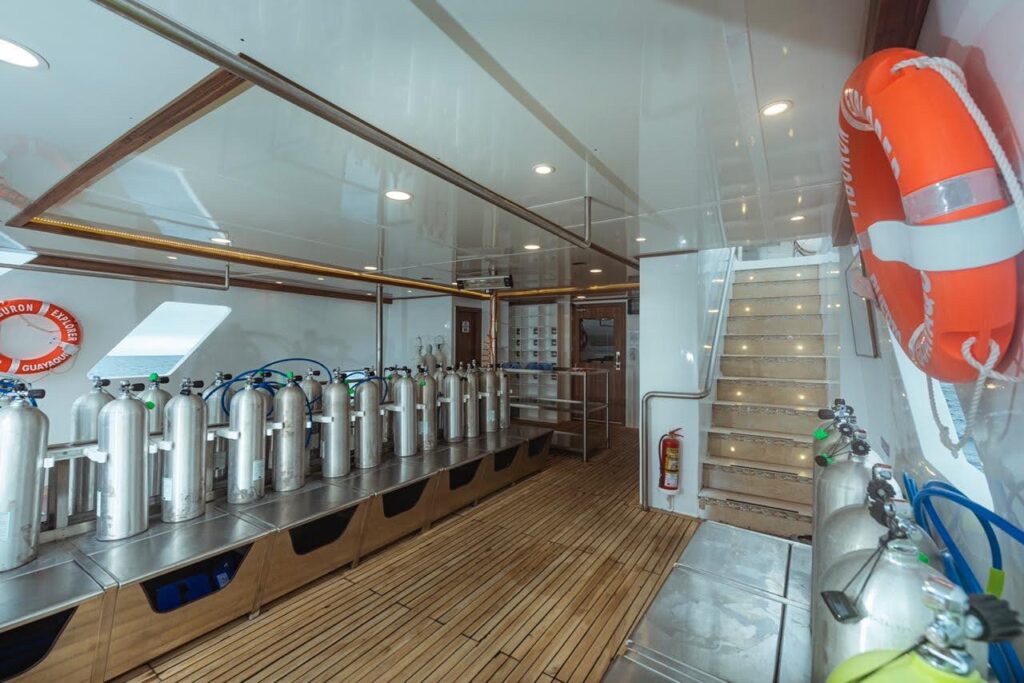
On deck of the Tiburon Explorer | © Explorer Ventures Fleet®
Liveaboards face a unique set of sustainability challenges because they operate as self-contained businesses in remote environments. Crews take care of guests around the clock while repeatedly visiting some of the world’s most sensitive marine ecosystems. Even small operational decisions can have an impact over time. Those same realities also create opportunities that are harder to replicate in other types of dive operations.
Instead of diving once then heading home, guests spend days immersed in the experience, sharing meals, conversations, and dives with the crew. That extra time allows for deeper education about the marine environment and the challenges it faces. Crews develop a deep familiarity with the dive sites they visit, often returning to the same locations week after week and noticing subtle changes that others might never see.
One of the most valuable outcomes of the Eco-center journey has been the opportunity to contribute liveaboard perspectives back into the broader Green Fins (or sustainability) conversation. Explorer Ventures maintains ongoing communication with The Reef-World Foundation around liveaboard operations, helping identify areas where guidance, resources, and tools can better reflect the realities of multi-day vessels operating in remote destinations.
Applying Green Fins standards aboard a liveaboard requires flexibility and adaptation, but the underlying philosophy remains the same: minimize environmental impact, help divers become more responsible ocean stewards, support conservation efforts, continually look for ways to improve, and share the message.
Beyond the Badge
For Explorer Ventures Fleet, the value extends beyond the designation itself.
The process helped strengthen existing programs, create greater consistency across operations, and provide a clearer framework for evaluating environmental performance. It also offered an opportunity to demonstrate what sustainability can look like aboard a liveaboard operating in one of the world’s most remote and highly protected marine environments.
Becoming a PADI Eco-center was not a quick or simple process. It required months of coordination, materials translation, documentation, reviews, and implementation across two active vessels operating in the remote and highly regulated environment of the Galapagos Islands.
Today, Humboldt Explorer and Tiburon Explorer remain the only PADI Eco-Centers operating in the Galapagos. For the crews, managers, and staff involved, the designation represents years of steady work behind the scenes. It also reflects a shared commitment to operating responsibly in one of the world’s most extraordinary marine ecosystems.
Ready to elevate your dive operation’s sustainability standards? Become a Green Fins Member today.