
The Dive Starts at Home
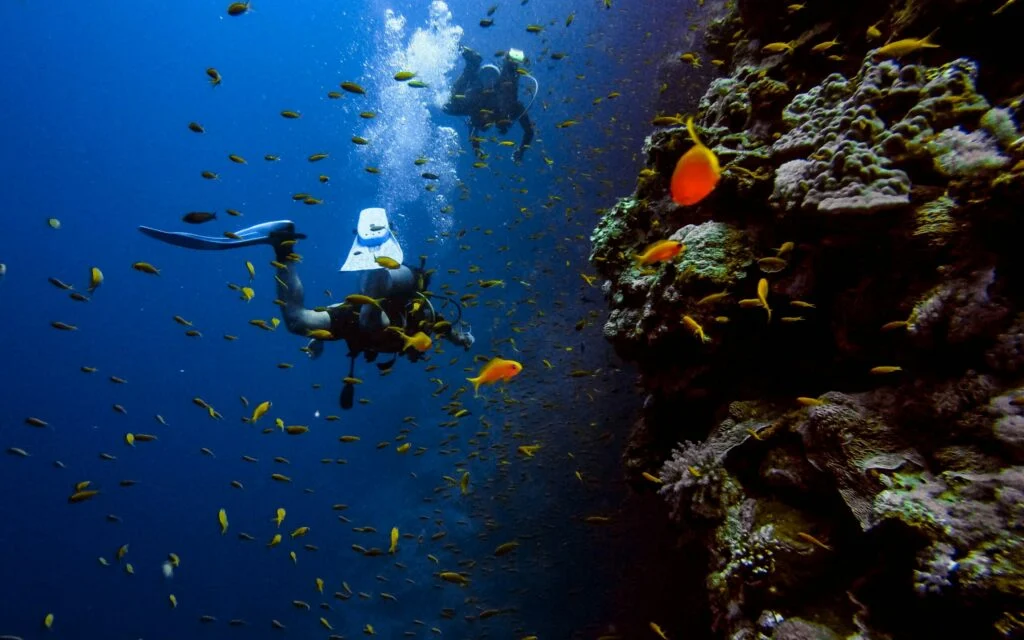
You don’t have to wait for your fins to get wet before you start making choices that protect reefs. The whole diving industry revolves around you; what purchases or bookings you make, whether or not you tip your guide, what feedback you give. As the consumer, you have power – you choose what you want to demand, and the industry will supply. This module is designed to help you make the best choices for the environment, based on the Green Fins code of conduct.
CHOOSING AN ENVIRONMENTALLY FRIENDLY DIVE OPERATOR
Operators that integrate environmental considerations into their business models are not always easy to spot. Some may have joined a certification scheme, others may just be doing the hard work without marketing it. Here are some tips to help you choose an operator in line with your environmental values:

Environmental AWARDS for dive operators
Sustainability awards give visibility to dive centers’ sustainability efforts. However, it is important to know what is behind the logo. Some are regional whilst others are global. Some assess compliance independently, others are self evaluated by the operator. Some are focussed on strictly environmental policies, others may also include social best practices. Below we give a few examples to get you started!
| Programme | What does it involve? | Where can you find it? |
| PADI Eco Center (for dive businesses) | Participation in the PADI AWARE Adopt the Blue™ program Be an active Green Fins Certified or Digital Member Demonstrate outstanding environmental performance through Green Fins membership based on the Green Fins Code of Conduct, and commit to continuous improvement by implementing an action plan and engaging in the Community Forum | Global (PADI businesses only) |
| PADI Torchbearer (for individuals) | Donate to PADI AWARE Foundation Participation in the PADI AWARE Adopt the Blue™ program Promote PADI AWARE Foundation’s 10 Tips for Divers To Protect the Ocean. | Global (PADI training centers only) |
| Green Fins Certified Member (for dive, snorkel and Liveaboard businesses) | Members pledge to follow the 15-point Code of Conduct. Members have their environmental practices assessed by trained assessors annually Staff receive annual environmental training Member must improve based on a recommended action plan to stay active in the programme | Countries that adopt Green Fins as a national programme |
| Green Fins Digital Member (for dive, snorkel and Liveaboard businesses) | Member operators pledge to follow the 15-point Code of Conduct. Members conduct an online self-evaluation of their environmental practices annually Member must show commitment by developing an Action plan and participating with Green Fins online tools | Global |
| Longitude 181 (for dive businesses) | Operators submit self-evaluation based on three criteria. Awarded up to four ‘Planets’ based on results. | Global, focus on CMAS operators |
| SSI Blue Oceans Center (for dive businesses) | Promote the SSI Sustainable Diver Code and Blue Oceans Philosophy Provide training in Perfect Buoyancy, Photo, Video, and SSI Ecology programs Organise min. one clean-up or environmental protection event annually Receive Digital Blue Oceans handbook | Global (SSI Training Centers only) |
(Last updated 8 July 2024)
Contact your operator for more information
You can also dive a little deeper and email or message the operator with more specific questions when considering booking:
How many divers are allowed per group?
It is considered environmental best practice to limit diver groups to maximum 4 divers per guide (1:4).
Are check dives mandatory?
It is considered environmental best practice to do a check dive at the start of any dive trip, regardless of your experience. This allows
Do you organise trips where food is used to attract wildlife?
Feeding wildlife like fish (including sharks) can have negative environmental impacts, affecting species health and behaviour, migration and have wider impacts on the ecosystem too.
What is your policy on divers touching the reef?
The dive operator should adopt a strict no-touch policy for reef activities, and their staff is proactive in correcting accidental contact.
What is your policy on divers wearing gloves?
Dive centres following best environmental practice should not allow the use of gloves for all tropical or warm water diving. Only legitimate medical reasons should be the exception.
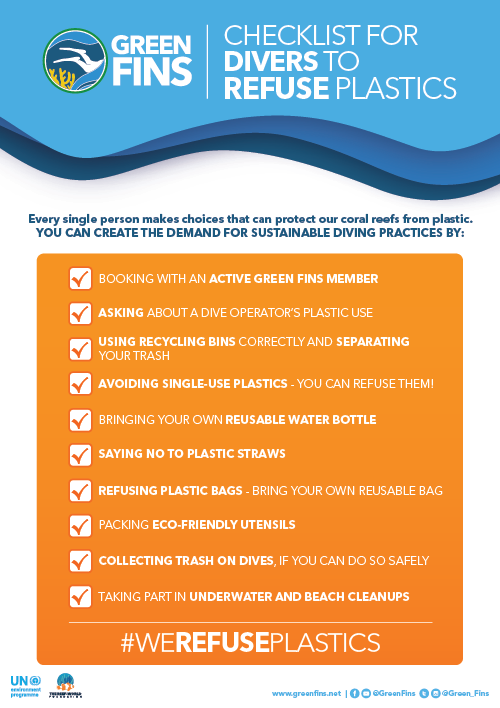
What efforts do you take to reduce waste or single use plastic?
Expect an outline of how the dive centre is taking steps to reduce their waste and single use plastic (e.g. offering water refills instead of bottled water and tea and coffee in jars instead of sachets, reusable lunch containers)
Are there mooring buoys in place at the dive sites or do you use an anchor?
It is best environmental practice not to use the anchor at coral reef sites, dive centres should be using moorings where available (or drift) and making efforts to support mooring buoy programmes where needed.
Are your staff trained in environmental best practices?
It is best practice to ensure all staff are trained to follow environmental guidelines and are aware of marine environmental laws & regulations.
Do you provide reef safe sunscreen?
It is good environmental practice to use sunscreen that is not harmful to the marine environment.
Do you participate in conservation efforts and how?
It is considered good environmental practice when dive centers regularly participate in conservation efforts such as beach clean ups, underwater clean ups, marine habitat and marine life monitoring programs.
Top Tip
Make it clear that you’ve made your decision to book (or not) with an operator because of environmental reasons.
WHAT TO PACK
It’s no secret that it takes a little extra planning and effort to reduce our environmental impacts. With a little preparation however, you can go on your dive trip equipped with everything you need to make positive choices:
There is an epidemic of single-use plastic use in many tourism destinations. Plastic water bottles are often seen as synonymous with safety but in reality there are numerous establishments that will provide safe drinking water or refill stations. In addition, tourism destinations in many countries are already struggling with waste management and overly full landfills. By bringing your own bottle you are reducing this pressure on the environment.
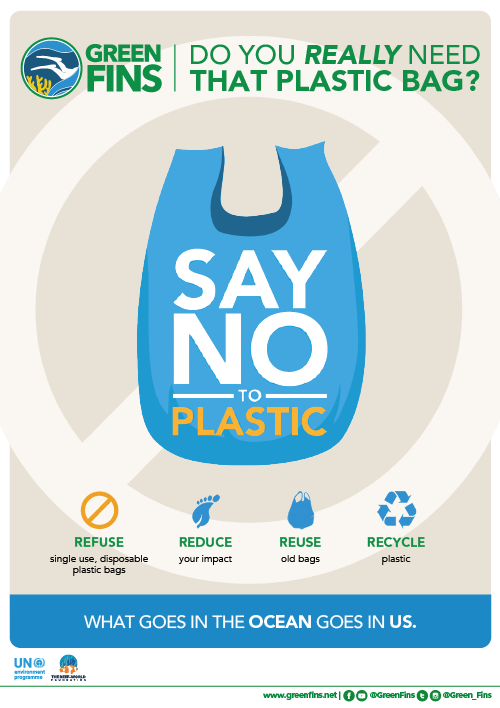
Help reduce the demand for plastic bags when on holiday and bring a cloth or waterproof bag that you can use again and again. Perfect for those airport purchases, souvenir shopping or even just to help carry your kit on and off the boat. Additionally, try to leave (and/or bring back) any non-biodegradable packaging at home where recycling options might be more readily available.
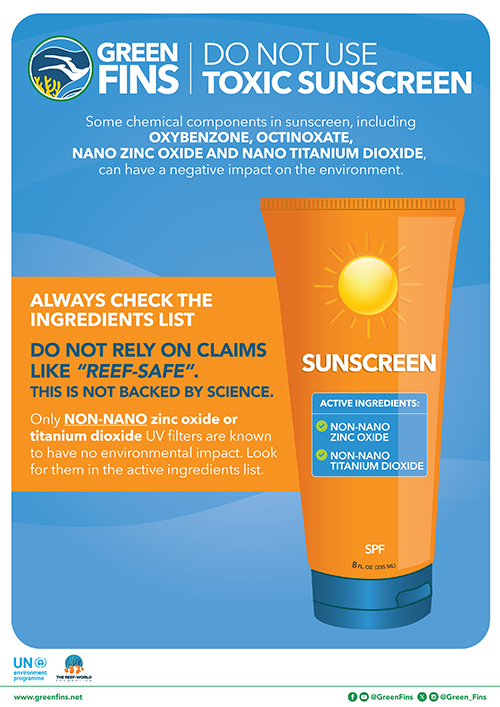
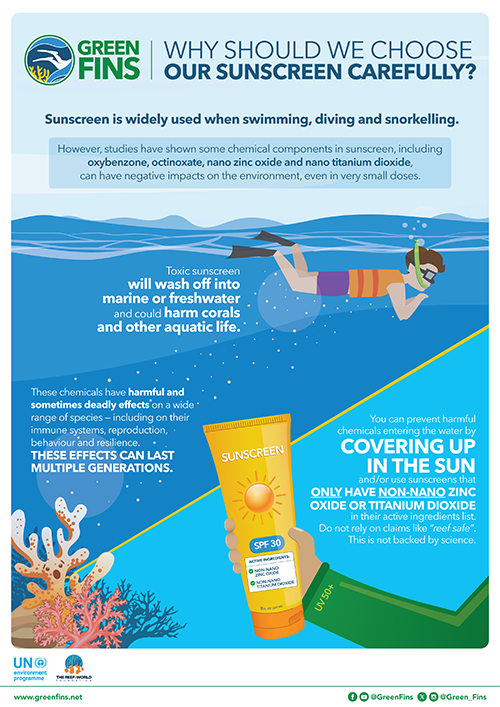
Lab studies have shown that chemicals commonly found in sunscreen, including oxybenzone and octinoxate, can cause corals to bleach, even in very low concentrations. This has led many popular tourism countries to ban traditional sunscreens as a precaution.
Brands have caught on and have started producing products without those toxic chemicals. This has led to the common use of the term ‘reef safe’. Be aware however that there isn’t a standard definition or regulation of the term ‘reef safe’, and those labelled as such may still contain ingredients that damage coral but are yet unknown. It’s best to check the ingredients of that sunscreen and ensure it doesn’t contain:
An estimated 6,000 tonnes of sunscreen washes into our reefs each year. Here are some tips to help reduce that impact:

Wearing gloves creates a false sense of security that divers are protected from things that can sting in the environment, and may encourage us to touch or hold onto coral. This theory is supported by a number of scientific studies that have analysed scuba divers and their interactions with marine life underwater. One study noted that the “use of gloves by divers correlated with an increased frequency of coral touches” (Camp and Fraser, 2012) and another significant study reported that “Divers who received pre-dive ecological briefings caused significantly less coral damage than those who did not, and divers with cameras and/or gloves caused the most damage.” (Kreiger and Chadwick, 2012)
Although the idea of wearing gloves does not seem like a big issue, many dive centres with good environmental policies will enforce a no-gloves rule. Remember that they are trying to ensure that all their customers do not feel tempted to make contact with marine life. In addition, gloves do not offer protection against stinging or venomous animals in the water or on the reef.
There may be some specific cases where you may need to wear gloves:
- Medical conditions
Some people have certain medical conditions or allergies where it is necessary for them to wear dive gloves. In these cases, bring a medical certificate so you can prove to management that you need to be exempt from their no glove policy. - Cold water diving
In this case, it could actually be a safety risk to stop divers wearing gloves. Always follow safety procedures and use your best judgement to determine when the conditions require gloves to be worn. - Mooring lines descents and ascents
Sometimes you will dive at sites that require assisted descent or ascent using a mooring line. Some examples of this are sites with strong currents, dives where you are with new or inexperienced divers or situations where you may require a slow and steady descent in order to equalise properly. Stinging plants such as hydroids can quickly grow on mooring lines and may be painful to touch. The best way to ensure that you do not get stung is to ask the dive centre if they regularly maintain the line to remove stinging plants. Secondly, only hold on by pinching their thumb and finger instead of gripping it with a full hand. The last option is to ask to only wear gloves for the ascent or descent, and remove the gloves for the remaining dive time.